Advancing from Able Seaman (AB) to Mate is one of the most important career milestones for professional mariners. The AB to Mate Program at MITAGS (Maritime Institute of Technology and Graduate Studies) is designed to help experienced deck personnel meet STCW-2010 training requirements, qualify for Officer in Charge of a Navigation Watch (OICNW), and move toward a U.S. Coast Guard Third Mate License (Oceans or Near Coastal).
If you have the sea time and ambition to step into an officer role, this program provides the structured training, practical assessments, and real-world relevance needed to succeed.
Key Facts: AB to Mate Program at MITAGS
Designed for: Able Seafarers with 1080 days of ocean sea service
Meets: STCW-2010 training requirements for OICNW
Supports: USCG Third Mate (Oceans or Near Coastal) licensing pathway
Training approach: Instructor-led courses with advanced bridge and ship-handling simulation
Outcome: Prepared to stand a navigational watch and advance to officer-level responsibilities
What Is the AB to Mate Program?
The AB to Mate Program at MITAGS is a structured training pathway that bridges the gap between unlicensed deck service and licensed officer status. The program combines required STCW courses, practical assessments, and simulation-based instruction to prepare mariners for the responsibilities of a Mate serving as Officer in Charge of a Navigation Watch.
Rather than navigating the licensing process course-by-course on your own, MITAGS organizes the training needed to help you progress efficiently and confidently toward your next credential.
Who Should Enroll?
This program is ideal for:
Able Seamen with at least 1080 days of qualifying sea service
Mariners seeking to upgrade to officer status
Deck personnel pursuing a Third Mate Oceans or Near Coastal license
Professionals looking to expand leadership opportunities and earning potential
If your career goal is to move from deck operations into navigation and watchstanding leadership, the AB to Mate Program is the logical next step.
What You’ll Learn in the AB to Mate Program
The AB to Mate curriculum covers the knowledge and competencies required by STCW and the U.S. Coast Guard for officer-level watchstanding. Courses focus on both technical mastery and real-world application.
Core Training Areas Include:
Navigation & Watchkeeping
Terrestrial, coastal, and celestial navigation fundamentals required for safe voyage planning and execution.Bridge Resource Management & Simulation
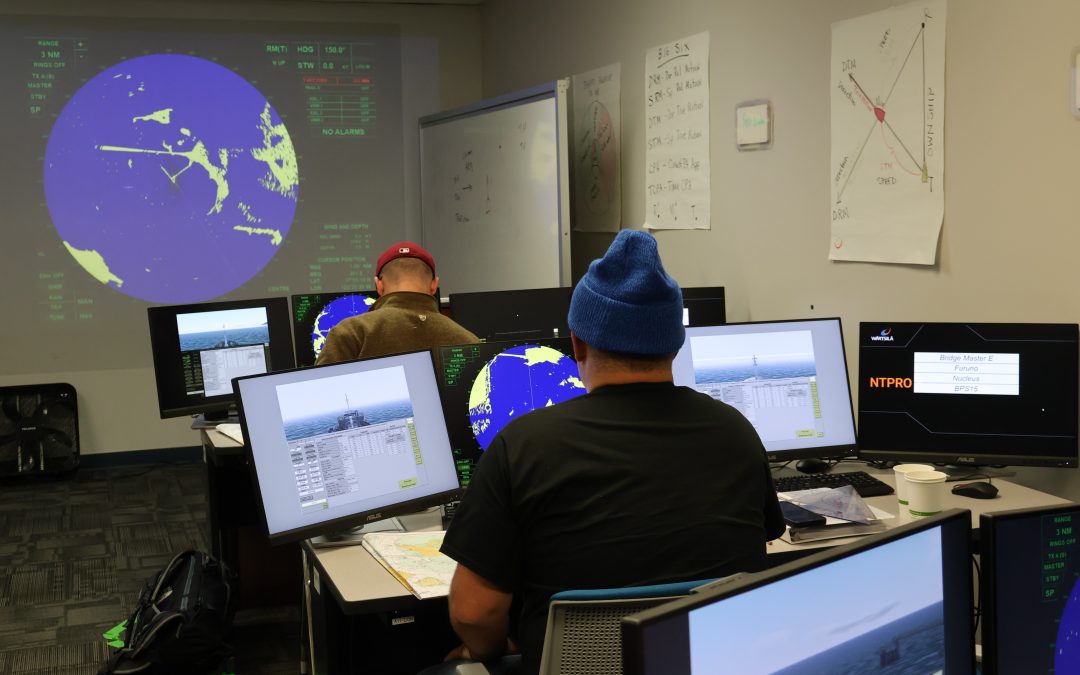
Hands-on bridge simulator training that mirrors real shipboard decision-making and teamwork.Radar & Collision Avoidance (ARPA)
Advanced radar plotting and collision avoidance techniques critical for safe navigation.ECDIS (Electronic Chart Display and Information Systems)
Training on modern electronic navigation systems used on commercial vessels worldwide.Shiphandling & Maneuvering
Practical shiphandling principles under varying environmental and operational conditions.Advanced Firefighting & Emergency Response
Leadership-level emergency preparedness and response training.
MITAGS instructors bring extensive sea experience into the classroom, ensuring that training is practical, relevant, and directly applicable on board.
Course Order & Planning Tips
Most AB to Mate courses may be taken in flexible order, with a few important exceptions:
Radar Observer Unlimited should be completed before ARPA and Watchkeeping
Terrestrial & Coastal Navigation should be completed before ECDIS, Watchkeeping, and Celestial Navigation
If taken, LAP (Leadership & Managerial Skills) should be completed last
MITAGS advisors can help you plan the most efficient course sequence based on your background and goals.
Optional Endorsements You Can Pursue
Qualified candidates may also choose to pursue additional endorsements alongside the AB to Mate Program, including:
Tankerman Person in Charge (TPIC)
Other endorsements based on sea service and career objectives
These optional credentials can further expand job opportunities and versatility at sea.
What Comes After AB to Mate?
Upon completing the required AB to Mate training, mariners are prepared to:
Apply for STCW OICNW
Sit for the U.S. Coast Guard Third Mate license examination
Continue advancing toward Chief Mate and Master licenses through MITAGS’ Mate-to-Master pathways
👉 MITAGS Programs Page
Why Choose MITAGS?
MITAGS is recognized internationally for professional maritime training that prioritizes safety, competence, and career advancement.
Mariners choose MITAGS because of:
STCW-compliant training
Experienced instructors with real shipboard backgrounds
Advanced simulation technology
Flexible scheduling across campuses
Strong reputation with maritime employers
Frequently Asked Questions (FAQ)
How much sea time do I need for the AB to Mate Program?
You need 1080 days of qualifying ocean sea service to be eligible.
Does this program meet STCW requirements?
Yes. The AB to Mate Program satisfies STCW-2010 training requirements for Officer in Charge of a Navigation Watch (OICNW).
Will this help me get my Third Mate license?
Yes. The program prepares you for the USCG Third Mate Oceans or Near Coastal licensing pathway.
Is simulation used in training?
Yes. MITAGS uses advanced bridge and ship-handling simulators in many courses to build real-world skills.
How do I get started?
Visit the AB to Mate Program page or contact a MITAGS advisor to review prerequisites and upcoming course dates.
Take the Next Step in Your Maritime Career
Moving from Able Seaman to Mate opens the door to leadership roles, increased responsibility, and long-term career growth. The AB to Mate Program at MITAGS provides the training foundation you need to confidently step into officer-level watchstanding and progress toward your U.S. Coast Guard license.
👉 Ready to advance?
Explore course schedules and enrollment details on the MITAGS AB to Mate Program page.
Related Posts

MS Oceania Fire Teams attend Team Training in Seattle
For most of the crew aboard the M/S Oceania, June 19 was just another port call in Seattle. For a select few however, it was a chance to spend the day battling large shipboard fires. Not on Oceania, which was busy taking on stores at Pier 66, but fifteen minutes away, at the India Tango Marine Fire Training School.

Elisabeth Hoover Promoted to Executive Administrator at MITAGS-MCC
It is with great pleasure that we announce the promotion of Elisabeth Hoover, Academic Services Representative to MATES Program Executive Administrator, reporting directly to Executive Director, Eric Friend. As we move towards the future under new leadership with Executive Director, Eric Friend, we are excited to have formulated a succession plan that recognizes the skills […]

ROM Quarantine and Military Sealift Command
Close-quarters ships are no place for a fast-spreading virus. You can imagine how quickly diseases move when a large group of people is gathered in one place for a long time. To prevent this scenario from playing out, the United States Navy, and, more specifically, the Military Sealift Command, can impose a Restriction of Movement […]